Wednesday, 4 February 2015

What Exactly is Five Element Acupuncture?


Five Element Acupuncture, also known as Classical Acupuncture, is quite distinct from the more widely practiced Traditional Chinese Medicine (TCM). Although the Classical method of healing originated in China over 2000 years ago it was almost lost in the 20th century in favour of TCM, but thankfully is now seeing a resurgence.

So what then is the key difference between TCM and Five Element Acupuncture?

Contrary to its name, TCM is not as traditional as it sounds - it is a Westernised and standardised version of Classical Acupuncture, and is concerned with treating specific symptoms and syndromes with a specific combination of needles.

Five Element Acupuncture on the other hand, is a very ancient system of healing based on the early classical texts and beliefs from its Chinese origins. Its emphasis is on treating people rather than their symptoms, and as each person is an individual then no two people are treated in exactly the same way, even if they present with similar medical conditions.

These different schools of thoughts can be likened to the difference between using PC or Mac, or to cooking with electricity or gas - the desired outcome is similar, but the operating systems are not the same.

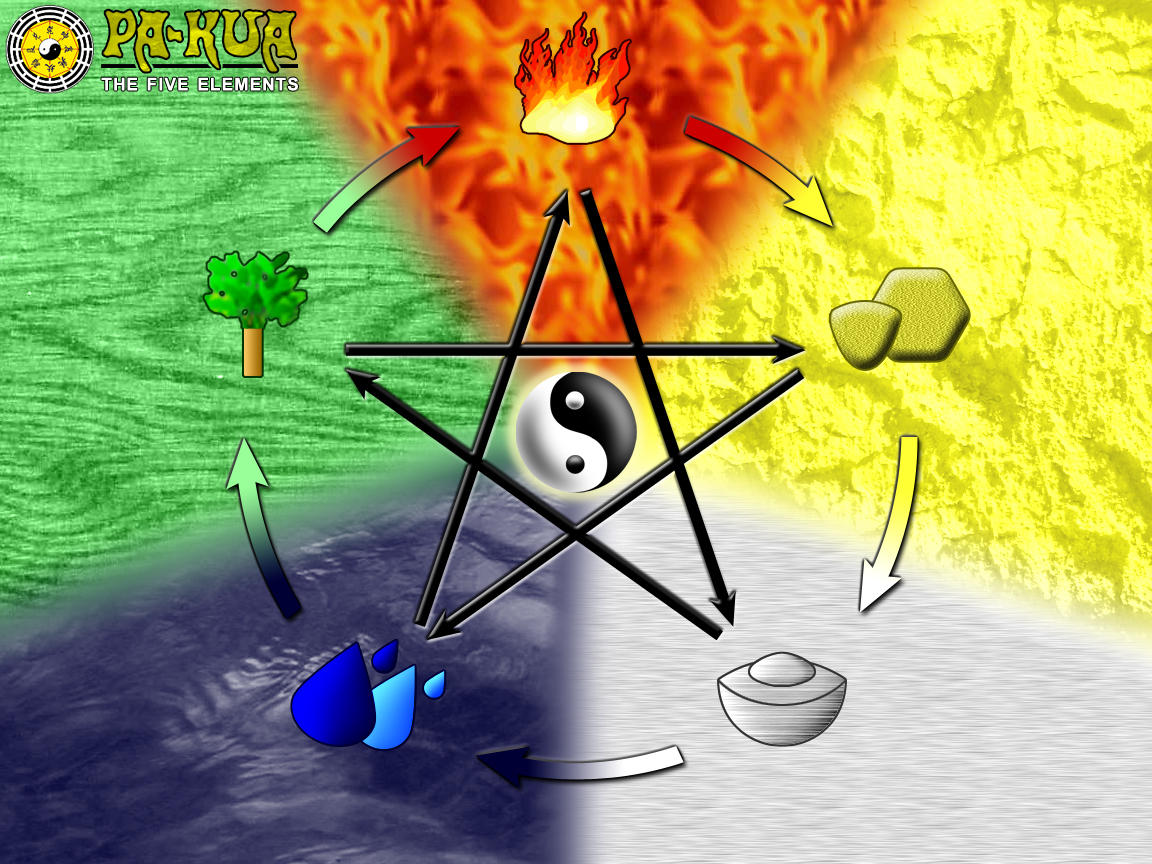
The ancient Chinese believed that a unique combination of five distinct elements (namely fire, earth, metal, water, wood) constitutes an individual's make up. Each element brings certain virtues, strengths and weaknesses to the person's character. Through a combination of nature and nurture, each of us develops a special relationship with one particular element, known as the Guardian Element, and this lends an emphasis to the way in which we conduct ourselves and our interaction with others.

It is the Guardian Element which bears the brunt of the majority of our life's stresses and becomes out of balance, showing its distress by allowing symptoms and pain to arise. Each element shows certain characteristics when in a well-balanced state, and inappropriate or extreme characteristics whilst imbalanced.

My role as a Five Element Acupuncturist is to determine the patient's Guardian Element by way of in-depth questioning and very close observation. Treatment is then tailored specifically with the intention of reinforcing the Element, so that a better emotional and physical balance can be reinstated, gradually enabling symptoms and pain to subside.

Five Element Acupuncture advocates the use of as few needles as possible in any one treatment. This is because each needle carries a distinct message and the body can easily be overwhelmed, particularly in early stages of treatment.

For further information regarding treatment, please visit www.jobanthorpe.co.uk


Monday, 15 December 2014

Are We Becoming a Chronically Ill Society?


The BBC last week that one of the most comprehensive health studies conducted recently found that over 50% of women regularly take 3 or more prescribed medications (43% of men). 5% of all prescriptions are for antidepressants, taken by 1 in 10 women and 1 in 20 men.

Cholesterol-lowering statins, pain relief and antidepressants were most commonly prescribed, and with an average of 18.7 prescriptions were issued per person, the total cost to the NHS was in excess of £15bn.

So there begs the question - are the nation's medics getting better at diagnosing illness?
Or rather - are we becoming a chronically ill society?

One wonders how much of this is down to people ignoring their body's warning signs and pushing themselves to the limit by working harder, faster and longer.

As a nation, our approach to our health tends to be reactive rather than proactive - we are more likely to seek medical help only when it is necessary, often by which time it is too late - we're possibly in need of medication and are already on the slippery slope to a lengthy period of recovery.

Taking responsibility for ourselves and adopting a proactive approach to healthcare means that looking after our own health and well being becomes a priority. Being more aware and listening to our bodies ensures that potential ailments can be nipped in the bud, or better still, we can choose to ease off sufficiently and allow ourselves time to recover and replenish before any signs of symptoms or illness arise.

But best of all would be to adopt a health maintenance regime in order to look after ourselves when we are in good health and to make sure we stay that way.  Whilst a healthy diet, regular exercise, taking regular breaks at work and having sufficient sleep will all help, these can be difficult to sustain at times. Far simpler would be to have monthly or seasonal acupuncture maintenance treatments - this will serve you very well and keep you on the right track health wise.

'If I am not for myself, who will be for me?
If I am only for myself, who am I?
If not now, when?'                    Hillel, 12th Century

One for the New Year's Resolutions list?


Tuesday, 18 November 2014

Confused by the Weather? You're Not the Only One ...


My garden doesn't seem to know what season it is at the moment!

My Japanese Maple has been in its full autumn glory for a couple of weeks now, but its not-so-distant cousin gave up the ghost about a month back and is absolutely starkers! Big brother, on the other hand, has hardly shed a leaf and is as green and lush as it was in the Springtime. 

I have winter-flowering cyclamen happily nodding their heads alongside pelargoniums and fuchsias, still going strong after having flowered all summer long. There are even primroses in full bloom, with daffodils and grape hyacinths promising a splash of colour this side of Christmas.

Mother Nature is sending us mixed messages too. The lack of daylight is telling our bodies that it's time to hurry indoors, to close the curtains and snuggle down in preparation for the cold nights ahead. But we've barely had a frost as yet, and the midday sunshine is enticing us outdoors without a coat. 

If our bodies haven't worked out what season it is then it's no wonder that so many of my patients tell me that they are really struggling with seasonal change at the moment. Having been buoyed for so long by the glorious summer, it seems that the number of daylight hours has decreased far faster than the temperature has outside, and as a result many people's energies have plummeted.  

If any of this is resonating with you, then this is the ideal time for a Five Element Acupuncture seasonal treatment - to address any imbalance in energy, and to fortify you for whatever time ahead may bring.

Treatments for general well being offer an opportunity for reflection, replenishment and relaxation, and some well-deserved 'Me Time'.

I always recommend that patients adopt a proactive approach to their well being rather than a reactive one - if we only seek treatment for illness and pain then we've already left it too long. 

It is vitally important that we take responsibility for looking after ourselves and our health - because if we don't do it,  then nobody will do it for us. 


Monday, 20 October 2014

Back to Basics - the Simpler, the Better


Whilst listening to Radio 2 the other day I heard a very interesting interview with Noel Fitzpatrick, Channel 4's 'Super Vet'. He was talking about his new TV series (of which I have yet to catch an episode) and my ears pricked up for several reasons - his obvious enthusiasm, love and devotion to his job; the lovely Irish lilt in his voice, which carried a real smile; but mostly because of something he said which really struck chord with me.

Noel was asked if he had ever come across a case which he didn't know how to treat, and it was this reply which will stay with me for a long, long time.

He said, 'People don't care what you know, they want to know that you care. That's the trouble with the medical profession these days - there's no point in having all this knowledge and qualifications if your bedside manner is zero. What's wrong with giving someone a hug in their time of need?'

He went on to say that because animals can't tell you what's wrong, vets have to really rely upon their senses to make a diagnosis - touch, sound, sight, smell, and their intuition. How very Five Element!

It just so happens that my late Father was a vet, and I was all set to follow in his footsteps until my body decided that it wasn't a great career choice for me (severe allergy to animals!). I used to spend as much time as I could with my Dad whilst he was working, despite the sneezes and wheezes. He was very much 'old school' in his approach and I remember him saying over and over how important it was to use the senses before anything else. He would despair at the new graduates came to work with him as they would run up enormous lab bills with blood tests, x-rays etc before even hinting at a diagnosis, and then they would proceed to prescribe very sophisticated (ie expensive) drugs. Dad always stuck to the generic forms - simpler, effective and much cheaper, and resorted to using the branded medications as a back up.

One other characteristic which my Dad definitely possessed, which I sensed this Vet also had, and which I aspire to possess - is courage. How courageous is any person who takes on cases when others have failed, given up on or who have shied away from, be it through fear (of failure) or lack of knowledge.

Our practice is a life long lesson which we undertake with honesty and humility. Often the most valuable lessons we learn are not through study or university, it is through life itself and our patients. It is up to us to be open and receptive to this knowledge, and never arrogant in assuming there is nothing more to learn.

Monday, 13 October 2014

Searching for the lost Mojo


'All illness comes from within, so don't just scratch the surface.'

I came across this statement the other day and it got me thinking. Of all the patients who have presented with physical symptoms or chronic medical conditions, I can safely say that in every single person there was a significant emotional undercurrent present.

These heightened emotions arise from a wide range of situations, most commonly relationship difficulties, bereavement, stress (financial, and work-related) and detrimental life-style factors.

The ancient Chinese were the first to recognise the correlation between emotional health and physical health, which is why Five Element Acupuncture is concerned with regaining a better emotional and spiritual as well as physical balance.

Many of my patients found they were able to talk about their emotional issues during their first acupuncture appointment, and for some it was the first opportunity they had had for years to 'get things off their chest'. What the sessions offer is the opportunity and time for patients to say whatever is on their mind, in a safe place where they can be heard without fear of being judged or discriminated against. There is no prescriptive advice offered, merely encouragement to discover alternatives and explore options.

The result is usually a mixture of relief, as if a huge weight has been lifted; clarity, with a plan for a way forward; an increase in motivation, self-awareness and self-esteem - and exhaustion, always!

And why exhaustion? Think of all of your holiday stuff being packed into a bag and held out at arms length. It's not how big or how heavy the bag is that matters - it's how long you hold it for. You have to let it go eventually to give yourself a break. Same goes for your emotional baggage.

We all deserve to give ourselves a break sometimes.


Tuesday, 12 August 2014

Sunbathing in the Rain


I've just read 'Sunbathing in the Rain' by author and poet, Gwyneth Lewis. She describes it as a 'cheerful book about depression'. A bit of an oxymoron it ever I've heard one, but it's exactly what she says it is. It is the author's account of her experience of severe depression - and she writes it very well, with wit, humour and a huge amount of honesty and humility.

One passage near the beginning of the book is particularly poignant and contains some very wise words which have arisen from her close observation of the illness.

She says, 'If you can cope with the eternal nuclear winter of depression and come through it without committing suicide - the disease's most serious side effect - then, in my experience, depression can be a great friend. It says: the way you've been living is unbearable, it's not for you. And it teaches you slowly to live in a way that suits you infinitely better. If you don't listen, of course, it comes back and knocks you out even harder the next time, until you get the point.'

She has realised that her depression 'isn't a random chemical event but has an emotional logic' which kicks in when she's not listening to what she really knows, when she's being wilful and harming herself.

Depression can be caused on the one hand by a significant imbalance in the blood's chemistry, the result of some underlying pathology of  an organ responsible for the body's day to day function; it can also be down to a combination of genetic inheritance, emotional habit and stressful life events.

Stress is the precursor to depression if ignored over a period of time. So if you're constantly feeling stressed out, then this is your body telling you something. It's saying to you that the way you're living is not working for you and something needs to change. Stress is enormously sapping of energy, but change requires energy and a lot of effort in order to initiate and sustain it. 

Depression sets in when your energy supply has been exhausted - you no longer have the resources to sustain the lifestyle you have chosen, but unfortunately you don't have the energy to initiate change either. This is the point when your body will go into recovery mode - and you may become incapable of doing anything other than sleeping. Minor day to day chores can become overwhelming and even the energy required to get dressed can seem more than is needed to climb Mount Everest. 

The solution? Listen to your body. If it's telling you to rest, then do just that. Nourish yourself - physically and emotionally. Don't be afraid or too proud to ask for help. Seeking help is not a sign of weakness - it's a sign of maturity in that you have recognised that there's something you're struggling with - and you're willing to take responsibility and to do something about it.

And tap into your support network - family, friends, GP, therapist. Talk to someone - it's always good to talk, when the time is right and when you feel ready to do so. Sometimes you just need to hear yourself saying out loud all of those things that are going round in your head. Find someone who will listen to you without judging you or giving you advice - the answers to all of our problems come from within, we sometimes need a bit of time, space and guidance to find them.

'If you bring forth what is in you, what you bring forth will save you. If you do not bring forth what is within you, what you do not bring forth will destroy you.' 

Monday, 21 July 2014

Do you Love Your Car More than Yourself?


I have come to realise that as a nation, and perhaps even as a species, there is a tendency towards a reactive rather than a proactive approach to health and well being.

Whilst most of us will seek treatment or advice when we're ill or in pain, on the whole we're not very good at looking after ourselves in order to prevent illness and to STAY WELL.

Certainly, most of us take our car in for regular service and MOT - whilst the latter is a legal requirement, the former is because it's such a pain if the car breaks down. Why then, don't we do the same for ourselves? After all, if a car is broken beyond repair it's easy to just buy another one. The same cannot be said about the human body.

Increasingly, we push ourselves to work harder, longer and faster until - guess what? The body says 'Enough!' - the result being the sudden onset of illness or pain, or a recurrent or chronic symptom. We duly trot along to the GP or therapist in search of that 'quick fix' that will help us get better and back onto that gruelling treadmill as soon as possible.

The trouble is, although we may feel better in the short term and we're able to pick up from where we left off, if we keep going at the same pace as before it's pretty certain that a recurrence will be on the cards sooner rather than later.

So how can we prevent this happening again?

The answer is to implement change. When illness, pain and symptoms occur, it is your body telling you that something in your lifestyle isn't working well for you. It is a warning sign - and you need to listen.

One change could be to ease up on yourself - don't work so hard, long or fast. Easier said than done though, in today's climate of financial and peer pressures.

If this is not an option for you, then TAKE TIME TO LOOK AFTER YOURSELF. Ring-fence an hour a month minimum for 'Me Time' - and hour a week would be better - to replenish and nourish yourself. Do an hour of yoga; have a treatment or a massage; go for a quiet walk; have an uninterrupted soak in the bath; SWITCH OFF YOUR PHONE!!

And don't give your car more TLC than you give to yourself.